
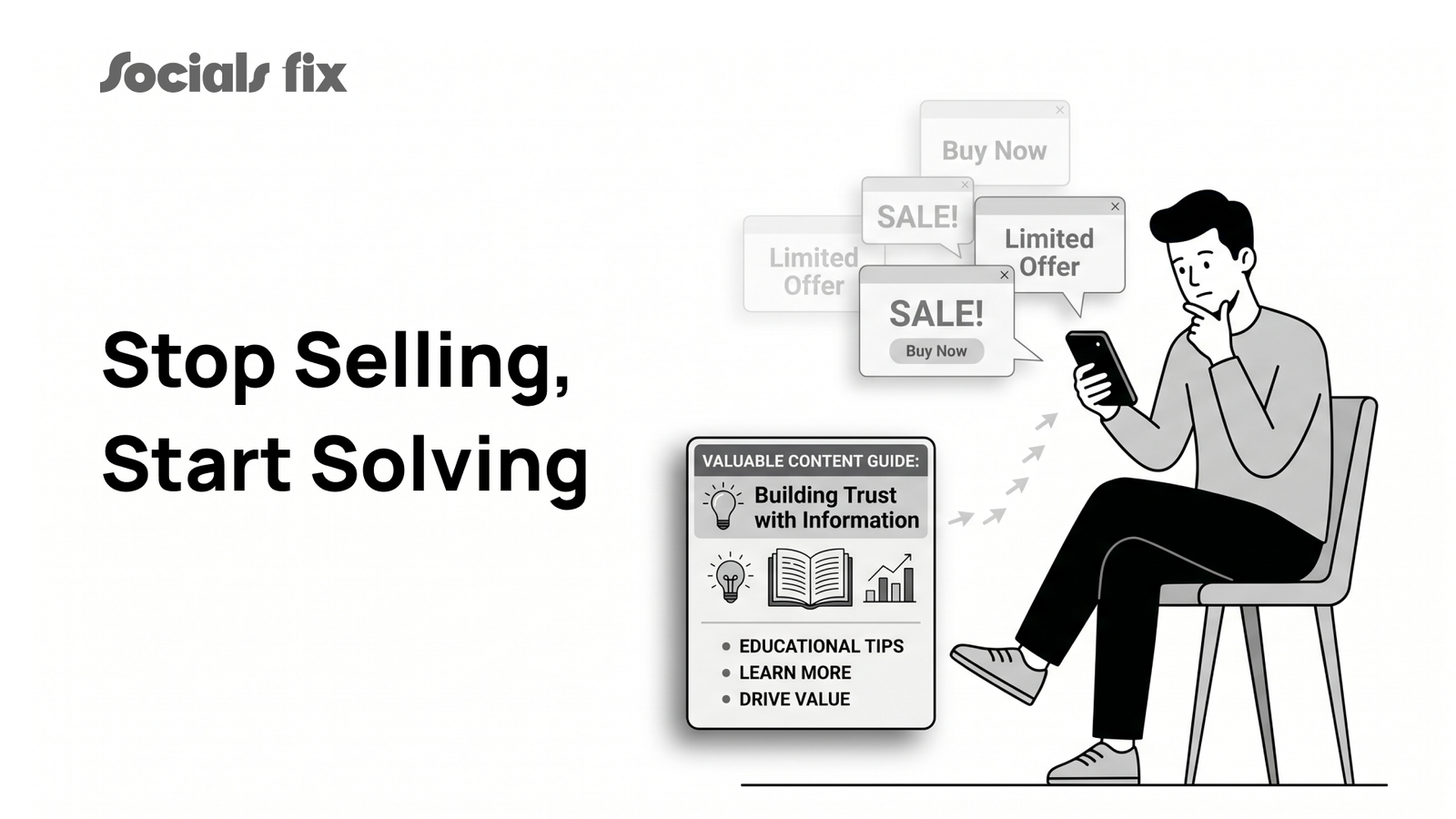
Most “Buy Now” posts get ignored.
Not because the product is bad. Not because the copy is wrong. Because the person seeing it wasn’t ready to buy and nobody took the time to get them there first.
That’s the problem nobody wants to admit. And it’s why so many brands post constantly and see almost nothing back due to lack of social media content strategy.
The 97% Problem
At any given moment, roughly 3% of your audience is ready to buy. Maybe less.
The other 97%? They’re somewhere in between, aware of a problem, loosely curious, vaguely interested, not convinced yet, not urgently looking. They scroll past your offer not because they’re not your customer. Because you reached them too early.
If all your content is selling, you’re spending 100% of your effort on the smallest possible group. The real opportunity, the growth, the brand loyalty, the compounding revenue, is sitting in everyone else.
The mistake isn’t selling. It’s only selling.
Where Your Audience Actually Is
Think of every buyer as moving through a few loose stages.
First, there’s the person who doesn’t even know they have a problem yet. They’re not looking for you. They don’t know they need what you offer. They’re just scrolling.
Next is the person who knows something’s wrong but hasn’t connected it to a solution. They recognise the frustration. They just haven’t found the fix.
Then someone who knows solutions exist and is starting to explore. Comparing, researching, thinking it over.
And finally the 3% actively ready to decide and spend.
Social media is mostly a discovery platform. People open it to scroll, to pass time, to feel something. Not to shop. The vast majority of people seeing your posts on any given day are in stage one or stage two. They need to understand the problem better before they’ll care about the solution.
Post content that talks to those stages and you’re building something that converts over time. Post only to stage four and you’re talking past almost everyone.
Why “Buy Now” Usually Fails
It’s not just ineffective. It actively gets in the way.
A “Buy Now” post dropped in front of someone who doesn’t yet trust you, hasn’t seen consistent value from you, and has no context for why they’d need what you’re selling, that’s not marketing. That’s an interruption. And people are extremely good at ignoring interruptions.
There’s no urgency. No foundation. No reason to click.
The algorithm doesn’t help either. Sales content tends to earn lower engagement because people scroll past it. Lower engagement means lower distribution. Lower distribution means fewer people see your content overall, including the content that actually could convert.
Sales posts don’t just underperform. They drag everything else down with them.
The Shift That Changes Everything
Here’s the reframe that matters: content isn’t for closing. It’s for warming up.
The job of your posts is not to convert right now. It’s to earn the right to convert later.
Think about the last time you bought something from someone online. You probably followed them for a while first. Saw their content a few times. Thought “this person knows what they’re talking about.” Maybe saved something. Maybe shared something.
Then when the offer came, it landed.
That’s not an accident. That’s a sequence. And sequence is the thing most brands completely skip when they jump straight to selling.
Old approach: “Here’s my product. Here’s the price.”
New approach: “Here’s something that helps you right now and by the way, we sell that thing.”
One of those builds demand. The other assumes it.
What to Actually Post for the 97%
Four content types work here. Mix them, don’t overthink them.
Educational content is the obvious one, and the most underused. Not long tutorials, not deep dives. One small, specific, useful thing per post. “Here’s why your Reels reach drops after 48 hours.” “The reason your hook isn’t working.” Specific beats broad every time. This content gets saved. Saves are one of the highest-weighted signals on Instagram. Every save is also a vote of trust.
Problem-aware content hits differently. Name the struggle out loud. “Posting every day and getting nowhere.” “Spending hours on content that nobody sees.” When someone reads that and thinks yes, that’s exactly where I am right now, you have their attention. Not because you sold them something. Because you showed you understand them. That feeling of being understood is rare. People follow accounts that produce it consistently.
Story-based content holds attention better than advice in most cases. Real things, even small ones. A campaign that flopped. A post that unexpectedly blew up. Something that shifted your thinking. People don’t connect with polished expertise. They connect with experience. Story is how experience travels.
Opinion-driven content generates conversation and conversation is algorithmic rocket fuel. Take a position on something in your niche. Disagree with a commonly held belief. Not controversy for its own sake. Just a real, honest take that some people will agree with loudly and others will push back on. Either reaction is engagement. Either reaction helps distribution. And having a point of view is what makes an account worth following in the first place.
The Silent Funnel (Social Media Content Strategy)
Nobody talks about this enough.
Most people think in terms of single posts. One post, one conversion. That’s not how it works.
What actually converts someone is a sequence of touchpoints over time. The first post creates awareness. They didn’t buy, but they remember you exist. The second builds a bit of trust. The third shows you know your stuff. The fourth makes them curious. The fifth makes them feel understood.
By the time you post something with a clear offer, you’ve already done most of the work. They’re not a cold audience anymore. They’re warm. The decision feels easy because it’s the product of ten small moments of trust, not one hard sell.
This is the silent funnel. It runs in the background, without a single automated email, without a paid retargeting campaign. Just consistent, useful content doing its job over time.
The brands that seem to “suddenly” blow up aren’t sudden at all. They’ve been building invisible demand for months. The sale is just the moment it becomes visible.
When to Actually Sell
Selling isn’t wrong. Timing is.
The right moment is after consistent value. After your audience has seen you show up and deliver something useful more than once. When demand signals start appearing organically, DMs asking questions, comments requesting more information, people tagging friends in your posts. That’s the audience telling you they’re ready.
When you do sell, keep it simple. A clear offer. A direct reason to act. No over-explaining, no 14-paragraph caption justifying the price. People who trust you don’t need to convincing. They need a clear path to buy.
If you feel like you need to justify hard, it’s usually a sign the trust isn’t there yet, not that the offer is wrong.
Mistakes Worth Avoiding
Posting only sales content. If someone visits your profile and every post is a pitch, they leave. No follow, no saves, no return. The profile itself has to feel worth following before the offer lands.
Over-explaining value to the point of exhaustion. Endless educational content with no clear direction leaves people informed but passive. Value without direction is just content. Eventually you need to connect what you’re teaching to what you offer.
Inconsistency. This one breaks the silent funnel. Three posts in a week, then nothing for three weeks, then a sales post. That’s not a sequence. That’s noise. Consistency is what creates the accumulated touchpoints that turn followers into buyers.
Copying trends without adapting them. Using a trending format and slapping your product on it without considering whether it actually serves your audience is how brands end up with high views and zero followers. The trend brings reach. Your relevance is what makes people stay.
A Simple Framework to Work From
Don’t overthink the ratio. But if you need a starting point:
70% value — education, insights, problem-awareness content that builds trust before asking anything
20% connection — stories, opinions, behind-the-scenes, the human side of the brand
10% selling — clear offers, directed CTAs, conversion content
Or think about it as a cycle:
Solve → Relate → Teach → Sell
Solve a problem in their world. Relate to where they are. Teach something specific. Then, when trust is built, sell.
This isn’t a formula you run once. It’s a loop. Every time you sell, you go back to solving and relating. That’s how the account stays warm.
The Long Game Wins
People buy from familiarity, not exposure.
Seeing your post once doesn’t build trust. Seeing it fifteen times over six weeks — that does. The goal of posting isn’t to convert today’s audience. It’s to build tomorrow’s buyers.
Stop chasing the 3% who are already ready.
Start building demand in the 97% who aren’t ready yet — but could be.
The difference between brands that struggle and brands that scale on social usually isn’t budget, or following size, or even content quality. It’s whether they understand that selling is the end of a process, not the whole thing.
Build the process. The sales follow.
🚀 Want a Social Media Strategy That Actually Builds Demand?
If you want to:
- Build content that warms audiences and converts without constant selling
- Create a posting system that generates DMs, saves, and real buyer interest
- Stop guessing what to post and start working from a strategy that compounds
- Have a team handle the execution while you focus on running your business
That’s what Socials Fix is built to do. 👉 Want to grow your social media let’s build content that sells without feeling like selling.