
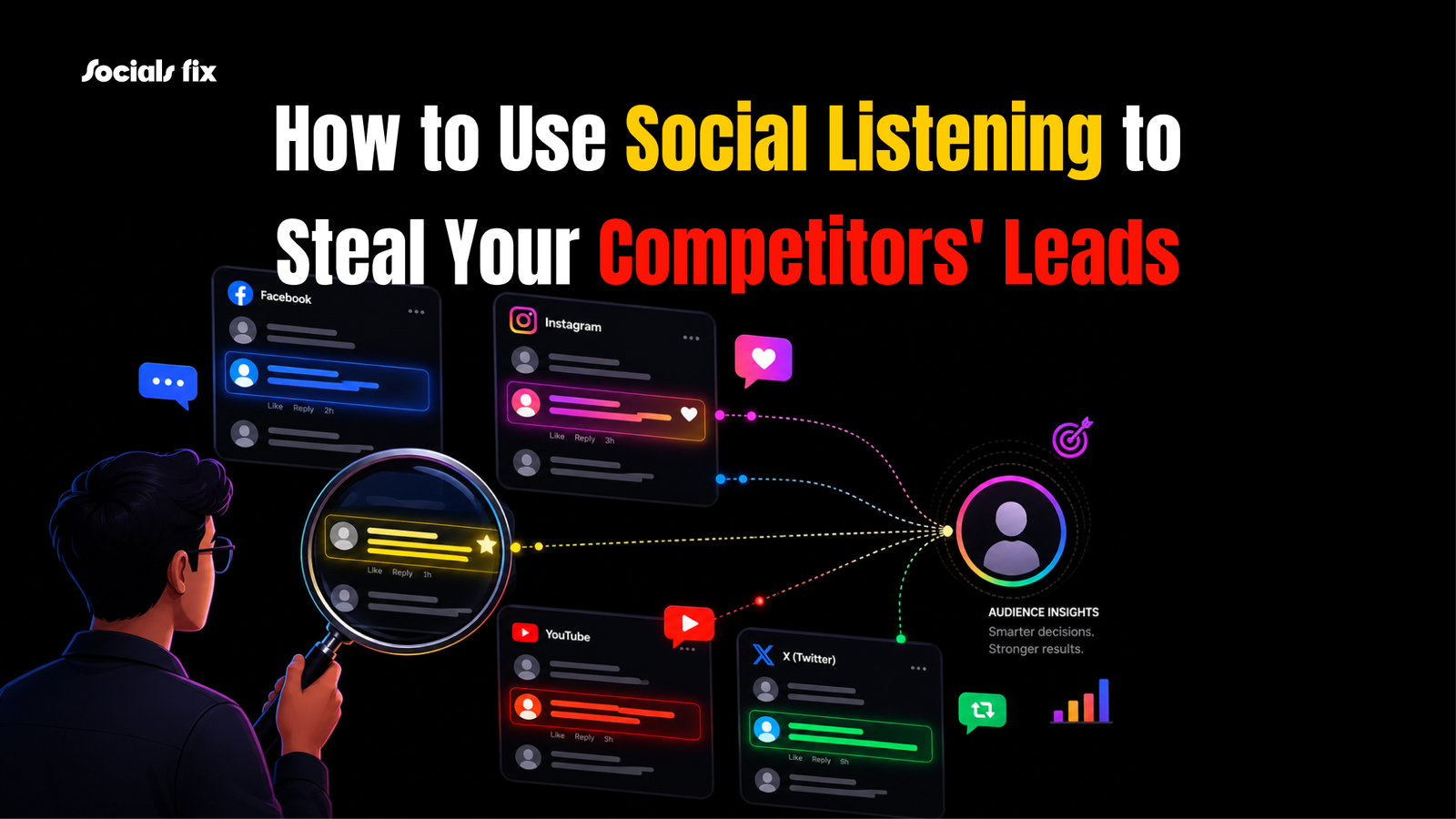
Your future clients are probably venting in someone else’s comment section right now.
Not exaggerating. Someone is typing “their support has completely fallen off” or “does anyone know a better option than [your competitor]” – and if you’re not paying attention, that conversation just disappears. Or worse, a competitor shows up, says something useful, and walks away with the client.
Most businesses wait to be found. Post content, run ads on social media, hope the right person stumbles across them. That works – slowly, expensively. Social listening is the other approach. You go to where the conversations are already happening and show up there instead.
It sounds obvious when you say it out loud. Most good strategies do.
This article covers:
- What social listening actually means and why it works better than cold outreach
- Where to find high-intent conversations right now
- The exact signals that tell you someone is ready to switch
- How to engage without looking like a spam account
- A daily workflow that takes 15 minutes
The Problem With Cold Outreach
Cold DMs have a timing problem. You’re guessing who needs you. You’re guessing when. And even when you guess right, you’re still a stranger interrupting someone’s day with a pitch they didn’t ask for.
Social media listening flips that.
You’re not guessing anymore. The person already said publicly that they have the problem. The need is confirmed before you type a single word. And when you respond helpfully – in public, where others can see – you build trust before any direct conversation even starts.
People respond when you join a conversation. They ignore you when you interrupt one. That’s the whole thing, really. Everything else is just logistics.
Where the Conversations Are Actually Happening
Three places worth your time.
Competitor comment sections. Go to your main competitor’s recent posts and read the comments – not the praise, the complaints. The unanswered questions. The “we’ve been waiting weeks for a response” replies. Those people are already mentally shopping around. They’re just waiting for a reason to leave.
Industry influencer posts. The audience following well-known creators in your space is full of people who are actively trying to solve problems. Comments under these posts include recommendation requests, buying signals, and frustration with existing providers. Rich territory.
Communities. LinkedIn groups, Reddit threads, Facebook groups – this is where people are most unfiltered. No brand filter, no professional polish. Just real problems being discussed openly with real urgency.
You don’t need to monitor all of them. Pick two or three places where your actual clients spend time on social media and go deep there rather than spreading thin everywhere.
The Signals Worth Acting On
Not every complaint is a lead. Vague frustration – “this platform is so annoying” – isn’t really actionable. You’re looking for intent signals. Specific ones.
The comments worth stopping for sound like:
- “We need to sort this before [date] – getting desperate.”
- “Thinking of switching providers – has anyone used [category] for this?”
- “Their support used to be brilliant. Something’s changed.”
- “I’ve tried everything. Nothing’s working.”
The deadline one is the best. Urgency combined with frustration means someone who’s not just complaining – they’re ready to move. That’s a different conversation entirely.
What to Monitor (And How)
Most people overcomplicate this. You can start with free tools and still find more leads than you have time to follow up on.
- Google Alerts – set up alerts for competitor names and intent keywords. Completely free and most businesses never bother.
- Native search – LinkedIn, X, and Reddit all have keyword search. Use it. Save the searches. Check them daily.
- Brand24 or Mention – worth paying for once you want to track volume and get notified faster
- Hootsuite – useful for managing multiple streams in one place once you’re scaling
The keywords that surface the best social mediaa leads:
- “Looking for an alternative to”
- “Anyone recommend a good”
- “Frustrated with”
- “Need help with [specific problem]”
- “Thinking of switching”
Set these up once. Takes 20 minutes. Then they run in the background.
The Daily Workflow
This doesn’t need to be a big production.
Every morning – 15 minutes. Check your saved keyword searches on LinkedIn and X. Scan the comment section on your top two or three competitors’ recent posts. Read any Google Alert emails from overnight. That’s it. Done.
Once a week – 30 to 40 minutes. Go deeper. Read a relevant Reddit thread. Browse two or three LinkedIn group discussions. Look at recent posts from industry influencers and check the comments. Note patterns – what problems keep coming up? What objections repeat? That information feeds your content strategy too, not just lead generation.
Consistency matters far more than depth here. Fifteen minutes every morning beats a two-hour session once a month by a significant margin. The leads you find on Monday might be gone by Friday.
How to Engage Without Being That Person
This is where most people get it wrong.
They spot an opportunity, get excited, and immediately pitch. The prospect clocks it instantly. Trust gone. Sometimes they report the comment. They always ignore it.
The only approach that works: lead with something genuinely useful. Actually useful. Not “useful” as a Trojan horse for a pitch – actually useful on its own terms.
If someone asks “what’s the best option for managing WooCommerce subscriptions without paying for an overpriced plugin?” – answer the question. Properly. If your service is a real fit, you can mention it briefly. If it isn’t, recommend something else. That honesty builds more credibility than fifty sales comments ever would.
Comments that work:
- A direct, specific answer to the question asked
- An insight from real experience – “We ran into this exact problem with a client last year, here’s what solved it”
- A resource that actually helps, even if it’s not yours
Comments that don’t:
- “DM me, I can help!”
- A copy-paste paragraph about your services
- Anything that reads like it was written for twenty different posts at once
One genuine comment in the right conversation is worth more than a hundred generic ones. And every public reply is visible to everyone watching that thread – usually far more people than just the one person you’re responding to. You’re not just talking to them. You’re building a reputation in front of their whole audience.
The Comment-to-Conversion Flow
Here’s how it actually plays out when it works.
A WordPress agency starts monitoring the comment section of a popular WooCommerce creator on LinkedIn. They spot a comment: “We’ve been with our current dev agency for two years but response times have become a real problem. Starting to look at alternatives.”
The agency replies – not with a pitch, but with a specific note about what questions to ask any agency before signing a contract. Practical. No sales angle.
The store owner reads it. Visits the agency’s LinkedIn profile. Sees clear positioning, a few case studies, a simple “book a call” CTA.
Three days later: a connection request, then a message.
No cold outreach. No ad spend. Just showing up with something worth saying at exactly the right moment.
That’s the whole model. The comment opens the door. The profile closes it.
Fix Your Profile Before You Start
This part gets skipped. Don’t skip it.
If someone reads your comment, thinks “that was actually useful,” clicks through to your profile – and finds a vague bio, no clear positioning, and no obvious next step – the lead evaporates. All that effort was wasted at the last inch.
Before you run a single search, make sure your profile has:
- A bio that states clearly who you help and what they get – no jargon, no personality fluff that says nothing
- Proof. A few posts, case studies, or results that show the thing is real
- One CTA. Not three. One. The most important next step, clearly visible
Your comment does the work of getting them curious.

Common Mistakes
Jumping into every conversation. You don’t need to comment everywhere. Fifteen high-quality comments in the right places are worth more than a hundred generic ones scattered across the internet.
Going promotional too fast. Even subtle self-promotion in a first comment lands badly. Add value first. Over multiple interactions if needed. The pitch – if there is one – comes much later.
Ignoring follow-up. If someone responds positively to your comment, that’s the moment. Don’t leave it there. Continue the conversation. Move it forward naturally.
Letting the profile undermine the comment. Covered above. Worth mentioning twice.
A Few Final Thoughts
Most businesses don’t have a content problem. They have an attention problem – they’re creating content on social media and hoping the right people find it. Social listening inverts that. You find the right people, in the middle of expressing a problem you solve, and you show up with something useful to say.
The leads are warmer. The trust-building is faster. The cost is time, not budget.
Your competitors’ unhappy clients are already talking. The brands that pay attention – and actually respond with something worth reading – are the ones that end up in the DMs.
✔ Targets people actively looking for a solution, not just browsing
✔ Builds public authority with every comment
✔ Generates inbound interest without cold outreach or paid ads
✔ Gets better with time as you learn where the best conversations happen
Social media isn’t just a broadcasting tool. It’s one of the best listening tools ever built. Most people just never use it that way.
🚀 Ready to Turn Social Conversations Into Real Enquiries?
If you want to:
- Build a social listening workflow that surfaces warm leads every week
- Rewrite your profile so it converts curious visitors into conversations
- Combine a content strategy with outbound listening for faster results
- Stop chasing cold leads and start showing up where warm ones already are