
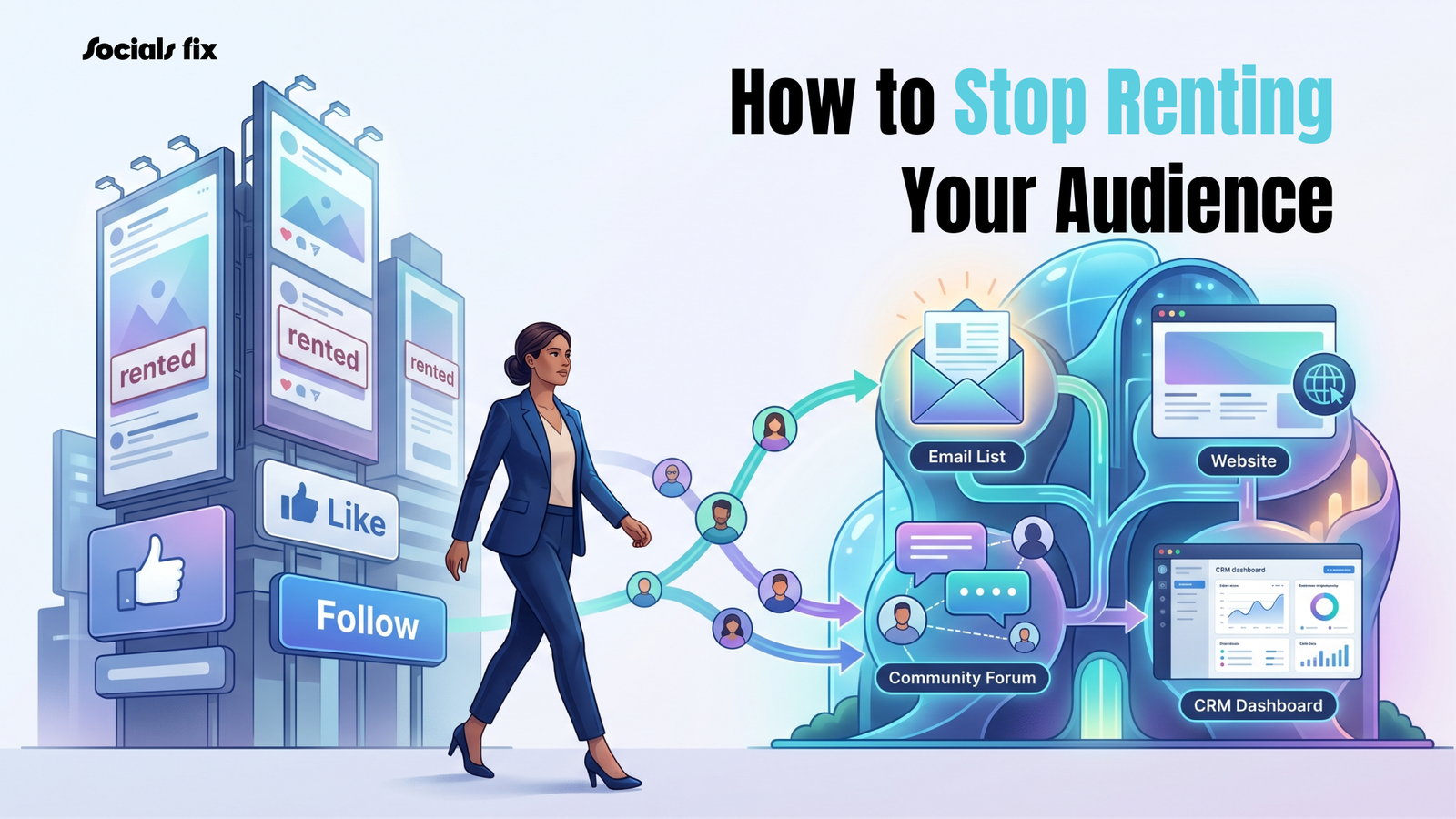
If Instagram disappeared tomorrow, what would happen to your business?
Not what would be annoying. What would actually break.
For a lot of brands, that question has an uncomfortable answer. The DMs stop. The enquiries dry up. The audience they spent two years building – just gone. And there’s nothing to fall back on because everything lived on one platform they never actually owned.
That’s not a content problem. That’s a structural one.
You Don’t Own Your Followers. The Platform Does.
Most social media advice skips this part in this article we let you know how to do it in detail.
Your followers don’t belong to you. They belong to Instagram. To TikTok. To Meta. Those platforms give you access to an audience – but access is not ownership, and access can be revoked, reduced, or quietly throttled any time the business model demands it.
Facebook page organic reach was around 16% in 2012. It sits between 1–3% in 2026. That’s not a glitch. That’s the platform deliberately narrowing the gap between free reach and paid reach, because a wider gap means more ad spend. You built the audience. They moved the goalpost. And they’ll keep moving it.
Instagram currently reaches around 5–7% of followers per post. So a brand with 20,000 followers publishes something – and roughly 1,200 people see it. The other 18,800 who explicitly followed and said yes to the content? The algorithm decided they didn’t need to see it that day.
This isn’t going to reverse. The economic incentive runs the other direction.
The Concept Worth Understanding
There’s a term for building your business on land someone else owns. Digital sharecropping.
You do the work. You invest time, money, creative energy. You build something that looks like an asset – a following, an engaged community, a content library. But the platform sets the rules. The platform controls the distribution. And when the rules change, which they will, all that investment is at the mercy of a decision made in a boardroom you’ll never enter.
This is not fearmongering. It’s just the business model working as designed.
The brands that understood this early have something the others don’t – an owned audience that no algorithm can touch. Email subscribers. SMS lists. Website visitors who came directly and left their details. People who exist in a database the brand controls.
A following of 80,000 on Instagram is impressive. An email list of 5,000 engaged subscribers is worth more. The Instagram following is accessed. The email list is owned. That distinction quietly determines how resilient a business is when platforms shift.
The Honest Audit
Three questions. Answer them honestly.
Where do most of your leads come from? If the answer involves one platform – “mostly Instagram DMs” or “our Facebook page drives most enquiries” – that’s concentration risk wearing the mask of success.
What would realistically happen if that platform changed its algorithm tomorrow or suspended your account? Not the dramatic version. The realistic one. How many enquiries would dry up?
How many email subscribers do you have? If the answer is “not many” or “we haven’t really focused on that yet” – that’s the gap.
Most businesses end up here not because they made bad decisions but because social media growth is visible and measurable and exciting. A follower count goes up. Engagement feels like traction. Email list building feels slow and unglamorous by comparison.
But slow and owned outlasts fast and borrowed every single time.
What To Actually Do About It
The answer isn’t to leave social media. That would be a different mistake. Social media is still one of the best discovery and awareness tools available – the reach problem doesn’t change the top-of-funnel value.
The answer is to change what social media is for.
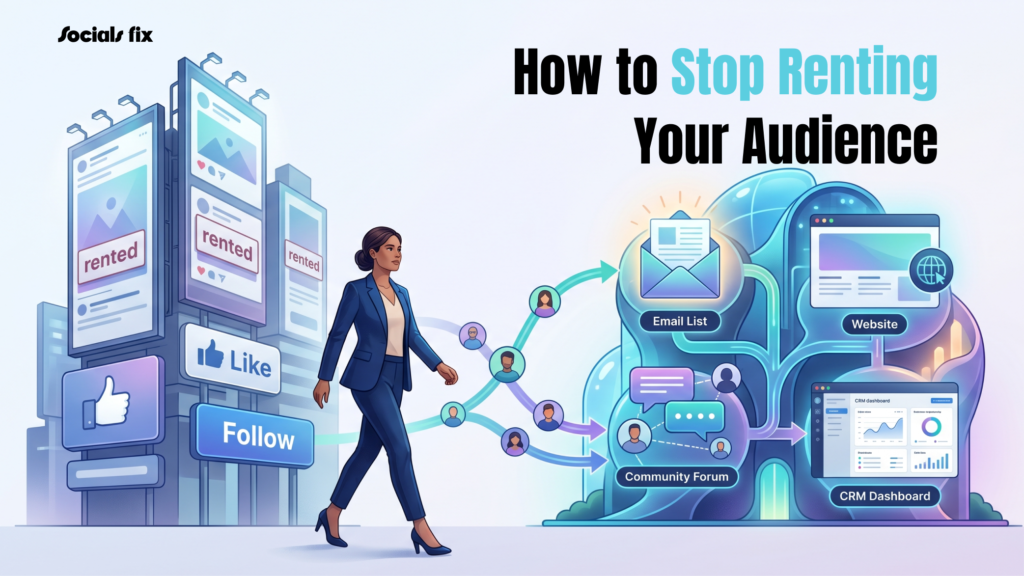
Its job is to attract attention and start relationships. That’s it. Every piece of content, every interaction, every post that performs should be moving people toward something you control. Not more followers. An owned contact.
Lead magnets are the most direct route. A free guide, a checklist, a template, a short resource that’s genuinely useful – something valuable enough that someone trades an email address for it. One well-promoted lead magnet builds a list faster than a hundred posts asking people to follow you. And the people who download it are warmer than most of your followers because they took a deliberate action to get it.
A newsletter worth reading beats posting more content on a platform that might show it to 6% of your audience. Email open rates for well-built newsletters sit between 30–50% for engaged lists. Compare that to Instagram’s 5–7% reach figure and the maths make themselves clear. The difference is you’re talking to people who signed up specifically to hear from you – not people the algorithm selected based on criteria you don’t control.
Webinars, free sessions, live events – anything that requires registration gives you a contact. Someone who shows up to a free session is significantly warmer than someone who watched a Reel and kept scrolling.
The mechanism matters less than the habit. Every piece of social content should have somewhere to go that isn’t just “follow for more.” A destination you own.
The Website Problem
This comes up less than it should.
A lot of businesses treat social media as their primary online home and their website as an afterthought updated once a year. That’s the wrong way round. Your website is the one piece of digital real estate you actually own outright – no algorithm, no platform policy, no monthly access fee to reach the people who land there.
If someone arrives from social media and leaves without giving you a way to follow up – no email capture, no contact form triggered, no lead magnet downloaded – you’ve spent the effort building the content and got nothing durable from it. The visit happened and then evaporated.
Drive traffic to the website. Make it easy to leave an email address there. Track which social content actually sends people there. That loop – social content → website → owned contact – is what durable audience building looks like in practice.
What This Looks Like When It’s Working
A fitness brand has 12,000 Instagram followers and a weekly newsletter with 2,400 subscribers. Their reach per Instagram post averages around 700 people. Their newsletter open rate sits at 38% – meaning roughly 900 subscribers read it every week.
They get more consistent engagement from the newsletter than from Instagram. And when Instagram changed its algorithm in early 2026 and their reach dropped 20%, the newsletter didn’t move. Same open rate. Same replies. Same bookings from people who’d been reading for months.
The Instagram following is still valuable – it’s how new people find them. But it’s not load-bearing. If it disappeared, the business wouldn’t collapse. That’s what owned audience means in practice.
The Mistakes That Keep Brands Stuck
Treating follower count as a health metric. Followers are a vanity number without context. What matters is how many of those followers you can reach directly, without the platform’s permission.
Ignoring email list growth until reach drops enough to feel urgent. By that point, you’re building from a weaker position. The time to build the list is when social media is working – because that’s when you have the most attention to redirect.
Using social media as a final destination. The post goes up, people see it, maybe they follow. That’s where most brands stop. The question worth asking every time: where do I want this person to go next?
Final Thoughts
Social media is one of the best acquisition tools available. It’s a terrible foundation for a business.
Use it for what it’s actually good at – discovery, awareness, the top of a funnel. Let it do the attracting. But the moment someone’s attention turns into genuine interest, the goal is to move them somewhere you control.
The brands that survive platform changes aren’t the ones with the biggest followings. They’re the ones who used those followings to build something underneath them. An email list. A direct relationship. An audience that exists in a place no algorithm can quietly reduce to 6% overnight.
✔ Audit where your leads actually come from – one-platform dependence is a risk, not a success metric
✔ Start building an email list before reach forces you to, not after
✔ Give every piece of social content a destination that moves people into an owned channel
✔ Your website is an asset – drive traffic to it and make it easy to capture contact details there
✔ Measure list growth and direct traffic alongside follower count – those are the numbers that compound
Want to grow your social media? Book a 7 days free trial.